
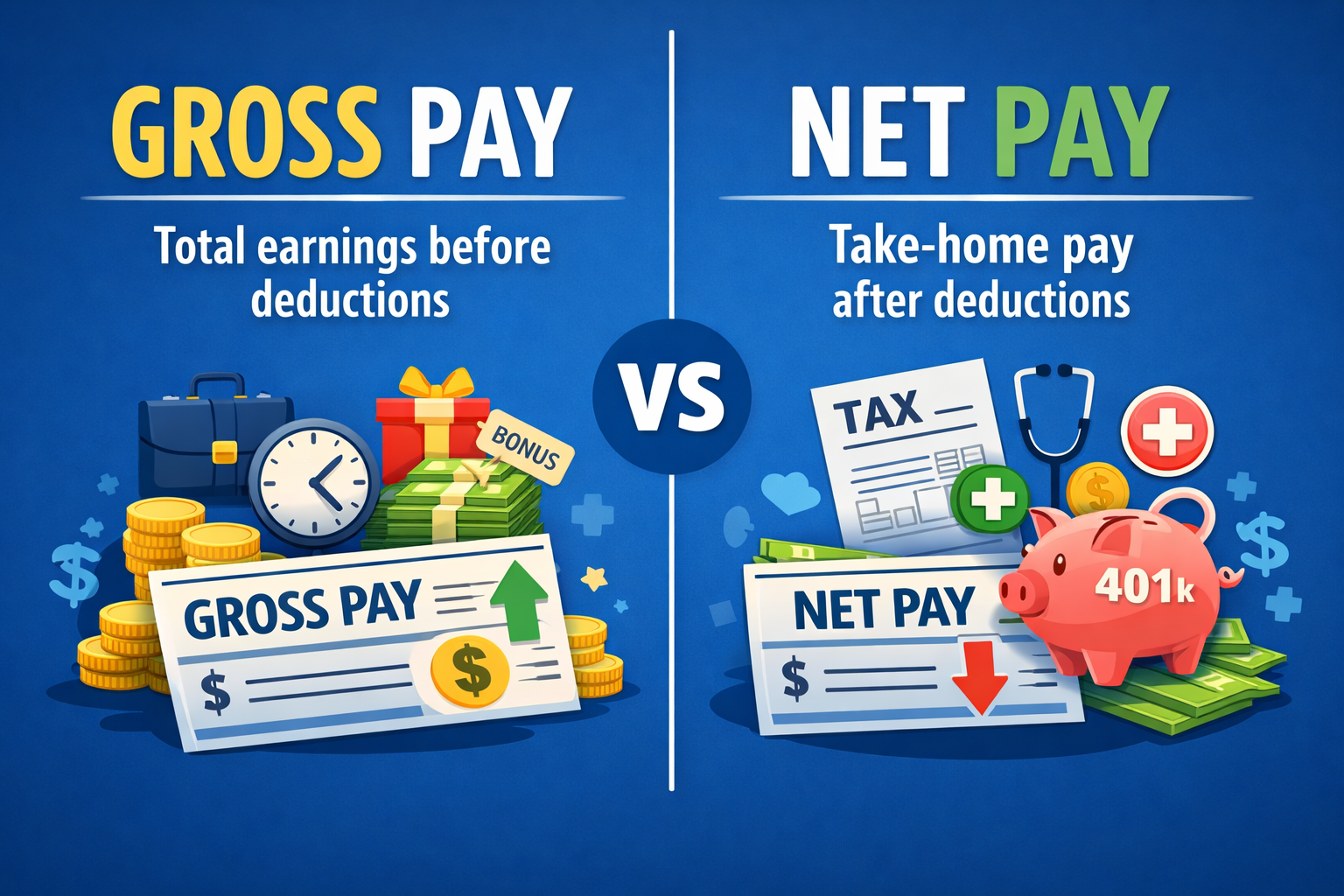
Gross Pay and Net Pay are two ways of measuring employee income.
Gross Pay is the total amount an employee earns before taxes and payroll deductions are removed.
Net Pay is the final amount an employee receives after deductions such as income tax, insurance, and retirement contributions are subtracted.
Because deductions reduce earnings, gross pay is always higher than net pay. Employees use gross pay to compare salaries, while net pay represents the real “take-home” income available for personal budgeting and expenses.
There are some really funny gross pay vs net pay meme which we will look later in the section along with Gross pay vs net pay formula and Gross pay vs net pay examples. So stay ahead for that!
Quick Summary

Gross pay is the total earnings before payroll deductions such as taxes and insurance.

Net pay is the final amount an employee receives after those deductions are subtracted.

In simple terms:

Gross Pay = Total earnings before deductions
Net Pay = Take-home pay after deductions
What Is Gross Pay?
Gross pay is the total amount of money an employee earns before any payroll deductions are applied. It includes base pay plus any extra earnings, such as overtime, incentives, and bonuses.
Employers calculate gross pay based on the employee’s salary or hourly wage during a specific pay period, such as weekly, bi-weekly, or monthly.
Gross pay represents the full compensation earned from work before taxes, benefits, or other deductions are removed.
Because gross pay includes all earnings before deductions, it is often used by employers and financial institutions to represent total income.
In simple terms, gross pay means the total wages earned before payroll deductions are applied.
Employers commonly use gross pay when discussing compensation with employees.
For example, a job offer may state a salary of $60,000 per year or $25 per hour, which represents earnings before taxes and deductions.
Gross pay is also used when determining income tax brackets and total taxable income.
Why Gross Pay Is Important
Gross pay plays an important role in payroll processing, taxation, and financial planning.
Employers use gross pay as the starting point for calculating payroll taxes, benefit deductions, and other withholdings during each pay period. Because gross pay represents total earnings before deductions, it provides a standardized way to measure employee compensation.
Government agencies also rely on gross pay when determining income tax brackets and payroll tax obligations.
In addition, financial institutions may consider gross income when evaluating loan applications, mortgage approvals, or credit limits.
For employees, gross pay is often used to compare job offers or evaluate salary levels because it reflects total earnings before deductions are applied.
What is Net Pay?
Net pay is the actual amount of money an employee receives after all payroll deductions are subtracted from gross pay.
It is your take-home pay after all tax deductions, health insurance premiums, and other withholdings are removed from your gross pay.
It is the money deposited into your bank account or the amount shown on your paycheck.
These deductions reduce gross pay to determine the employee’s final earnings for the pay period.
On your pay stub, net pay often stands out in bold or larger font, making it easy to distinguish from gross pay.
For example, if your gross pay is $550 but $100 is deducted for federal income tax, state taxes, and FICA taxes (Social Security and Medicare taxes), your net pay would be $450.
Because payroll deductions are removed from gross pay, net pay is always lower than gross pay.
Employees typically focus on net pay when managing personal finances because it reflects the actual money available for spending, saving, and budgeting.
Why Net Pay Is Important
Net pay represents the actual amount of money an employee receives after payroll deductions are applied.
Because net pay reflects take-home income, it is the amount employees use for everyday financial decisions such as paying bills, budgeting, saving, and managing expenses.
While gross pay shows total earnings before deductions, net pay provides a clearer picture of the income available for spending.
Employees often review their net pay on a pay stub or bank deposit to understand how much money they receive after taxes, insurance premiums, and other payroll deductions.
Understanding net pay also helps employees evaluate how payroll deductions and benefit selections affect their overall take-home income.
Gross Pay vs Net Pay: Key Difference
Gross pay and net pay represent two different stages of employee earnings during payroll processing.
Gross pay shows the total amount earned before deductions, while net pay shows the final amount received after deductions are applied.
Understanding the difference between these two figures helps employees read their pay stubs, understand salary offers, and manage personal finances.
| Gross Pay | Net Pay |
|---|---|
| Total earnings before deductions | Final take-home pay |
| Used to calculate taxes and benefits | Used for budgeting and spending |
| Includes wages, overtime, bonuses, commissions | Includes only remaining income |
| Higher amount | Lower amount |
Where Gross Pay and Net Pay Appear on a Pay Stub?
Employees can usually find both gross pay and net pay listed on their pay stub for each pay period.
A pay stub provides a detailed summary of earnings and payroll deductions. It shows how an employee’s total earnings are reduced by taxes and other deductions to determine the final take-home pay.
Most pay stubs include the following information:
- Gross pay for the pay period
- Itemized payroll deductions
- Total deductions withheld
- Net pay (take-home pay)
Gross pay appears as the total earnings before deductions are applied. Net pay appears as the final amount the employee receives after taxes, benefits, and other payroll deductions are subtracted.
Reviewing a pay stub helps employees understand how their earnings are calculated and how deductions affect their final paycheck.
How to Calculate Gross Pay?
The method used to calculate gross pay depends on whether the employee is paid an hourly wage or a fixed salary during a pay period before deductions are applied.
Employers first determine the employee’s pay rate and pay period, then calculate the employee’s total earnings before taxes and payroll deductions.
The two most common ways to calculate gross pay are for hourly employees and salaried employees.
Each method calculates the employee’s total earnings for a pay period before taxes and payroll deductions are applied.
How to Calculate Gross Pay for Hourly Employees
To calculate gross pay for hourly workers, multiply the hourly rate or wage by the number of hours worked during the pay period.
For example, a part-time employee who works 40 hours at $25 per hour will have a gross pay of $1,000 ($25 × 40).
Formula:
Gross Pay = Hourly Rate × Hours Worked
If an employee works overtime, the overtime pay is added to the total gross pay.
For example, the same employee who works 40 hours at $25 per hour also works 5 hours of overtime. Overtime is typically paid at 1.5 times the regular hourly rate.
Since the employee earns $25 per hour, the overtime rate becomes $37.50 per hour.
The employee’s total gross pay is calculated as follows:
Regular Pay = $25 × 40 = $1,000
Overtime Pay = $37.50 × 5 = $187.50
Total Gross Pay = $1,187.50
In this example, the employee’s total gross pay for the week is $1,187.50 before taxes and payroll deductions are applied.
How to Calculate Gross Pay for Salaried Employees
For salaried employees, gross pay is calculated by dividing the employee’s annual salary by the number of pay periods in a year (e.g., 12 for monthly, 24 for semi-monthly, 26 for bi-weekly, 52 for weekly).
Formula:
Gross Pay = Annual Salary ÷ Number of Pay Periods
For example, if an employee earns $60,000 per year and is paid monthly, the gross pay per paycheck would be $5,000.
Here’s how:
Gross Pay = $60,000 ÷ 12
Gross Pay = $5,000
Common pay period schedules include:
- Weekly (52 pay periods per year)
- Bi-weekly (26 pay periods per year)
- Semi-monthly (24 pay periods per year)
- Monthly (12 pay periods per year)
What Is Included in Gross Pay
Gross pay includes all earnings an employee receives during a pay period before taxes and payroll deductions are applied.
These earnings can come from several types of compensation, including base wages and additional forms of income earned from work.
The most common components included in gross pay are listed below.
Base Pay
Base pay is the fixed amount an employee earns for performing their job duties.
It may be paid as an hourly wage or as a fixed salary. For hourly employees, base pay is calculated by multiplying the hourly rate by the number of hours worked.
For salaried employees, base pay is the agreed annual salary divided across pay periods.
Base pay forms the largest portion of gross pay for most employees.
Overtime Pay
Overtime pay is additional compensation earned when an employee works more hours than the standard work schedule.
In many payroll systems, overtime is typically paid at 1.5 times the regular hourly rate.
These additional earnings are added to the employee’s regular wages and become part of total gross pay.
Bonuses
Bonuses are extra payments given to employees as rewards for performance, company profits, or meeting specific goals.
Examples include performance bonuses, annual bonuses, and sign-on bonuses.
When bonuses are paid during a pay period, they are included in gross pay before deductions.
Commissions
Commissions are payments earned based on sales or business generated by an employee.
Sales professionals often receive commissions as a percentage of the revenue they generate.
These earnings are added to base pay and become part of total gross pay.
Allowances and Other Earnings
Some employees may receive additional payments such as allowances or incentives.
Examples may include housing allowances, travel allowances, shift differentials, or other work-related payments.
When these payments are included in an employee’s paycheck, they are counted as part of gross pay.
Examples of Gross Pay
Let’s look at simple gross pay examples calculated in real-world payroll situations.
Example 1: Hourly Employee
An employee earns $20 per hour and works 40 hours in a week.
Formula:
Gross Pay = Hourly Rate × Hours Worked
Calculation:
Gross Pay = $20 × 40
Gross Pay = $800
The employee’s gross pay for the week is $800 before taxes and payroll deductions are applied.
Example 2: Hourly Employee With Overtime
An employee earns $18 per hour and works 40 regular hours plus 10 overtime hours.
Overtime is paid at 1.5 times the regular hourly rate.
Overtime rate:
$18 × 1.5 = $27
Calculation:
Regular Pay = $18 × 40 = $720
Overtime Pay = $27 × 10 = $270
Total Gross Pay = $990
The employee’s total gross pay for the week is $990 before deductions.
Example 3: Salaried Employee
An employee earns $72,000 per year and is paid bi-weekly.
Formula:
Gross Pay = Annual Salary ÷ Pay Periods
Calculation:
Gross Pay = $72,000 ÷ 26
Gross Pay = $2,769.23
The employee receives $2,769.23 gross pay per paycheck before taxes and deductions.
How to Calculate Gross Income?
Gross income represents the total amount an employee earns over a longer period of time, such as a month or a year, before taxes and payroll deductions are applied.
Gross income is calculated by multiplying the employee’s gross pay by the number of pay periods in a year.
Formula:
Gross Income = Gross Pay × Number of Pay Periods
Gross Income example:
If an employee earns $700 in gross pay per week, the annual gross income can be calculated as follows:
Gross Income = $700 × 52
Gross Income = $36,400
In this example, the employee earns $36,400 per year before taxes and payroll deductions are applied.
Gross income is commonly used when evaluating a person’s total annual earnings for financial purposes such as loan applications, tax reporting, and income verification.
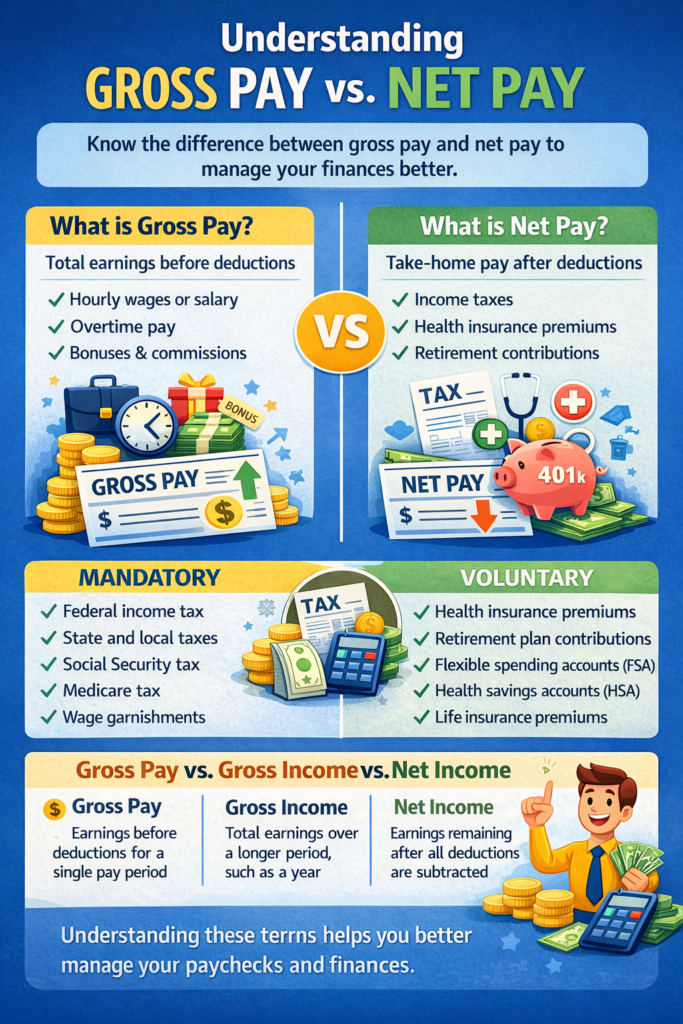
Gross Pay vs Gross Income vs Net Income
Although the terms gross pay, gross income, and net income are related, they describe different measurements of earnings.
Gross pay refers to the amount an employee earns during a single pay period before taxes and payroll deductions are applied.
Gross income represents the total earnings over a longer time period, such as monthly or annually, before deductions are taken out.
Net income, often called net pay, is the amount that remains after all payroll deductions have been subtracted from gross earnings.
For example, an employee may earn $1,000 in gross pay during a weekly pay period. Over the course of a year, this equals $52,000 in gross income. After taxes and other deductions are applied, the employee’s net income will be lower than the total gross income.
Understanding the difference between these terms helps employees interpret salary offers, evaluate annual earnings, and understand the income figures used in tax reporting and financial applications.
How to Calculate Net Pay?
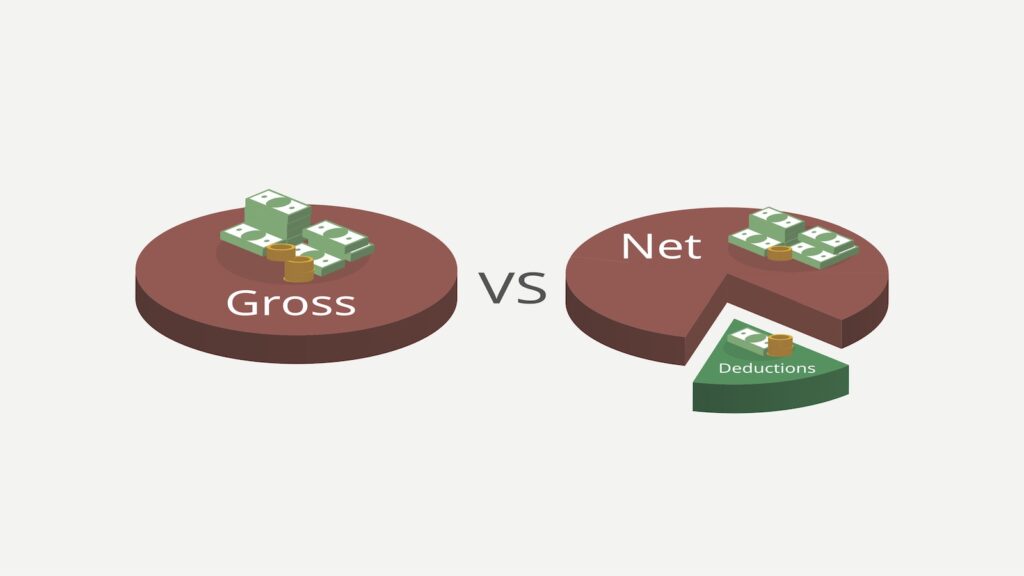
Net pay is calculated by subtracting all payroll deductions from an employee’s gross pay during a pay period.
Net Pay Calculation Formula:
Net Pay = Gross Pay − Total Payroll Deductions
Payroll deductions may include taxes, insurance premiums, retirement contributions, and other withholdings that reduce the employee’s earnings.
Net pay formula in excel:
The basic net salary formula in Excel is =Gross Salary - Total Deductions. It is computed by taking the total earnings (basic salary + allowances) and subtracting all deductions (tax, PF, insurance). For example, if Gross is in G2 and Deductions in H2, use =G2-H2
Basic Steps to Calculate Net Pay
Employers and HR professionals generally follow these steps when calculating net pay during payroll processing:
- Calculate gross pay using the hourly rate multiplied by the total hours worked or the salary divided by the number of pay periods.
- Subtract pre-tax deductions, such as health insurance premiums or retirement contributions like a 401(k).
- Withhold payroll taxes, including federal income tax, Social Security, Medicare, and applicable state or local taxes.
- Apply other deductions, such as wage garnishments or additional voluntary deductions.
After all deductions are applied, the remaining amount is the employee’s net pay, also known as take-home pay.
Example
If an employee earns $1,200 in gross pay and has $300 in total deductions, the net pay is calculated as follows:
Net Pay = $1,200 − $300
Net Pay = $900
In this example, the employee receives $900 as take-home pay after payroll deductions are applied.
Typical Payroll Deductions From Gross Pay
Payroll deductions reduce an employee’s gross pay to determine the final net pay received during a pay period.
These deductions are amounts withheld from wages for taxes, benefits, or other obligations. Some deductions are required by law, while others depend on the employee’s benefit selections or financial obligations.
Payroll deductions generally fall into two main categories: mandatory deductions and voluntary deductions.
Mandatory Payroll Deductions
Mandatory deductions are required by government regulations and must be withheld from employee wages during payroll processing.
Common mandatory deductions include:
- Federal income tax
- State income tax
- Local income tax
- Social Security tax
- Medicare tax
- Court-ordered wage garnishments
Employers are responsible for calculating and withholding these amounts based on tax rules and payroll regulations.
Voluntary Payroll Deductions
Voluntary deductions are optional and depend on benefits or programs chosen by the employee.
Examples of voluntary payroll deductions include:
- Health insurance premiums
- Retirement plan contributions such as 401(k)
- Flexible spending accounts (FSA)
- Health savings accounts (HSA)
- Life insurance premiums
- Union dues
Although voluntary deductions are optional, they still reduce an employee’s gross pay when calculating net pay.
What Affects Net Pay?
The compensation that employees get to take home depends on a variety of payroll deductions, some of which may be voluntary (such as health insurance premiums and retirement contributions), whereas others are mandatory (such as federal income taxes, Social Security taxes, and Medicare taxes).
These deductions vary depending on government tax regulations, employer benefit programs, and employee elections.
Federal Income Tax Withholdings
Federal income tax is one of the primary deductions taken from employee wages.
The amount withheld depends on the employee’s income level and the progressive tax bracket system used by the federal government.
Employers calculate the withholding amount based on payroll tax rules and the employee’s tax information provided during hiring.
This deduction reduces the employee’s gross pay when calculating net pay.
State and Local Income Taxes
In many regions, employees must also pay state or local income taxes.
These taxes are calculated separately from federal taxes and are deducted from gross pay during payroll processing.
Some states use progressive tax brackets similar to federal income taxes, while others apply flat tax rates or have no state income tax at all.
Certain cities and municipalities may also impose additional local income taxes.
Social Security and Medicare Taxes
Employees also contribute to government social programs through payroll taxes.
These taxes are commonly known as FICA taxes (Federal Insurance Contributions Act taxes).
They fund programs such as retirement benefits and healthcare coverage for eligible individuals.
The typical payroll tax rates include:
- Social Security tax: 6.2% of wages
- Medicare tax: 1.45% of wages
These amounts are automatically deducted from gross pay when calculating net pay.
Wage Garnishments
Wage garnishments occur when a court orders an employer to withhold a portion of an employee’s earnings to repay an outstanding debt.
Examples of wage garnishments include:
- Child support payments
- Student loan repayments
- Credit card debt
- Medical bills
- Back taxes or unpaid obligations
When a garnishment order is in place, the required amount is deducted from gross pay and reduces the employee’s net pay.
Health Insurance Premiums
Employees who participate in employer-sponsored health insurance plans may contribute a portion of the insurance premium.
These payments are typically deducted from employee wages during each pay period.
Although employers often cover part of the insurance cost, the employee contribution still reduces gross pay when calculating net pay.
Retirement Savings Contributions
Many employees contribute part of their earnings to retirement savings plans through payroll deductions.
Common retirement plans include:
- 401(k) retirement plans
- Employer pension plans
- Other retirement savings programs
These contributions are deducted from gross pay and therefore reduce the employee’s net pay.
Form W-4 (Employee Withholding Certificate)
When employees begin a new job, they usually complete a Form W-4, which tells the employer how much federal income tax to withhold from their wages.
The form collects information such as:
- Filing status (single, married, head of household)
- Number of dependents
- Additional income sources
- Extra withholding preferences
The information provided on the W-4 directly affects the amount of federal income tax withheld from each paycheck, which ultimately influences the employee’s net pay.
Net Pay Examples
Consider an employee who earns $1,500 in gross pay during a pay period.
The following deductions apply:
Federal income tax = $200
Health insurance premium = $100
Retirement contribution = $75
Total deductions:
Total Deductions = $375
Net pay calculation:
Net Pay = $1,500 − $375
Net Pay = $1,125
In this example, the employee receives $1,125 as take-home pay after payroll deductions are applied.
Gross Pay vs Net Pay Meme
Here are some good memes that people have shared on Reddit, Facebook and LinkedIn.




FAQs
The following are answers to some frequently asked questions about Gross pay vs net pay:
Gross pay meaning?
Gross pay is the total amount of money an employee earns during a pay period before any deductions—such as income tax, social security, or retirement contributions—are taken out.
It includes hourly wages, salary, overtime, bonuses, and commissions. It is distinct from net pay, which is the amount actually received after taxes and deductions.
how to calculate gross pay per month?
Calculate monthly gross pay by adding your base salary to additional earnings like bonuses, commissions, and overtime, before taxes or deductions are taken. For hourly workers, multiply your hourly rate by hours worked in the month. It represents total income before any withholdings, such as taxes or health insurance
How to calculate gross pay from hourly rate?
Calculate gross pay by multiplying the hourly rate by the number of hours worked in a pay period (Rate x hours = Gross Pay). For overtime, pay 1.5x the rate for hours over 40. For example, $25/hour x 40 hours = $1,000 weekly gross pay.
How to calculate gross pay from salary?
To calculate gross pay from a salary, sum your base salary with all additional earnings—such as bonuses, commissions, and overtime—before any deductions like taxes or retirement contributions.
It represents the total amount earned in a pay period, often calculated as Annual Salary/Pay Periods (e.g., 12 months or 26 bi-weekly periods)
How to calculate gross pay from net pay?
To calculate gross pay from net pay, add all deductions (income tax, social security, retirement, insurance) back to the net amount. The formula is: Gross Pay = Net Pay + Total Deductions.
What is the difference between net pay and gross pay?
Gross pay is what employees earn before taxes, benefits and other payroll deductions are withheld from their wages. The amount remaining after all withholdings are accounted for is net pay or take-home pay.
Do bonuses count as gross pay?
Yes. Bonuses, commissions, overtime pay, and other additional earnings are included in gross pay because they are part of total compensation before deductions.
Is it better to be paid gross or net?
Gross wage encourages job stability as you know exactly how much you are paying each month. With net wages adding on tax and national insurance, you can easily forget about the added expenses which may result in having to let them go.
What is 40,000 net salary?
On a £40,000 salary, your take home pay will be £32,319.60 after tax and National Insurance. This equates to £2,693.30 per month and £621.53 per week. If you work 5 days per week, this is £124.31 per day, or £15.54 per hour at 40 hours per week.
Why is net pay lower than gross pay?
Net pay is lower than gross pay because payroll deductions are subtracted from total earnings. These deductions may include income taxes, Social Security and Medicare taxes, insurance premiums, retirement contributions, and other withholdings. After these deductions are applied, the remaining amount becomes the employee’s net pay.
Why is gross pay higher than net pay?
Gross pay is higher because it represents total earnings before taxes and payroll deductions are removed. Net pay reflects the remaining income after those deductions are applied.
Can two employees with the same gross pay have different net pay?
Yes. Two employees earning the same gross pay may receive different net pay amounts. This happens because payroll deductions can vary depending on tax filing status, benefit selections, retirement contributions, or other deductions such as wage garnishments.
Is gross pay the same as taxable income?
Gross pay is the starting point for calculating taxable income, but it is not always the same as taxable income. Certain pre-tax deductions, such as retirement contributions or health insurance premiums, may reduce the amount of income that is subject to taxation.
Which amount is more important for budgeting?
Net pay is generally more useful for budgeting because it represents the actual amount of money an employee receives after payroll deductions are applied. This is the amount available for spending, saving, and paying expenses.
Why do employers show both gross pay and net pay?
Employers display both gross pay and net pay on pay stubs to provide transparency about earnings and deductions. Showing both figures helps employees understand how their total earnings are reduced by taxes, benefits, and other payroll deductions.
What is the gross monthly salary?
Gross monthly income from employment refers to income earned from employment. For employees, it refers to the gross monthly wages or salaries before deduction of employee CPF contributions and personal income tax. It comprises basic wages, overtime pay, commissions, tips, other allowances.
Net salary meaning?
Net salary (or take-home pay) is the actual amount of money an employee receives in their bank account after all mandatory and voluntary deductions are subtracted from their gross salary.
Is net salary monthly or yearly?
Net salary is almost always referred to on a monthly basis as the actual “take-home” pay.
Gross salary vs basic salary?
Basic salary is the fixed, core amount paid to an employee before any additions or deductions, while gross salary is the total compensation, including the basic salary, bonuses, allowances (e.g., housing, transport), and overtime, before taxes are subtracted. Gross salary reflects total earning potential, whereas basic salary remains stable.
Common Payroll Terms Related to Gross and Net Pay
Several payroll terms are closely related to gross pay and net pay. Understanding these terms can help employees better interpret their pay stubs and payroll documents.
Taxable Income
Taxable income is the portion of earnings that is subject to federal or state income tax after certain deductions are applied.
Pre-Tax Deductions
Pre-tax deductions are amounts taken from gross pay before taxes are calculated. Examples include health insurance premiums, retirement contributions, and flexible spending accounts.
Post-Tax Deductions
Post-tax deductions are taken from wages after taxes are calculated. These may include union dues, wage garnishments, or certain insurance premiums.
Take-Home Pay
Take-home pay is another term for net pay. It represents the final amount an employee receives after all payroll deductions are applied.